
Why Your CPA Isn't Saving You Money
Business Taxes, Tax Savings Advice, Small Business Finance
Why Your CPA Isn’t Saving You Money (And What to Do Instead)
I write code for a living, but the most expensive bugs I’ve ever seen weren’t in production systems—they were in Business Taxes. As a senior software engineer who’s sat in too many year-end “surprise tax bill” meetings, I’ve learned something uncomfortable: your CPA probably isn’t designed to save you money. And it’s not because they’re bad at their job. It’s because their job is not what you think it is.
This article is a bit contrarian and intentionally eye-opening. If you’ve ever thought, “My CPA handles all that tax stuff,” this is for you. We’ll unpack the difference between tax filing and tax strategy, why CPAs are usually reactive, how their incentives are misaligned with your Tax Savings Advice goals, why you as a local business owner must take control, and what a truly good tax team looks like—using the same systematic, proactive thinking we apply to building reliable software. I’ll also share how firms like Big Life Financial are approaching this very differently.
Tax Filing vs. Tax Strategy: Two Different “Systems”
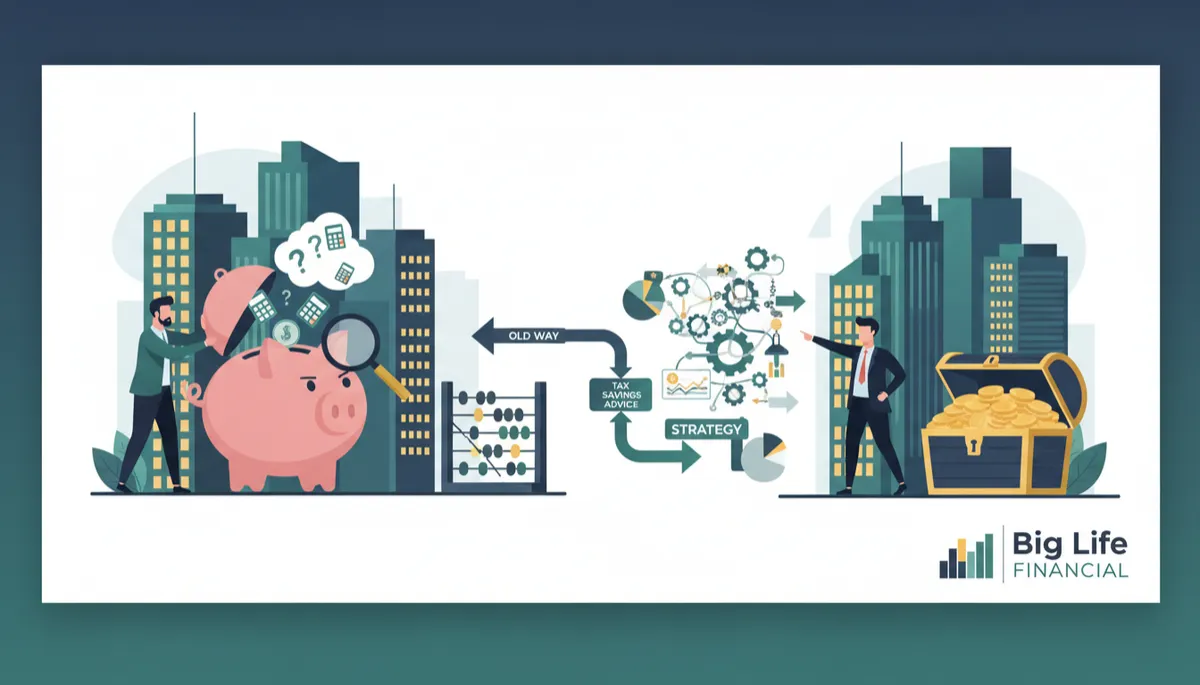
As engineers, we instinctively separate runtime from build-time. Filing your taxes is runtime: it’s taking what already happened and feeding it into the IRS’s “API” before a deadline. Tax strategy is build-time: designing your business structure, cash flow, and decisions so that when tax season comes, the output is optimized for Tax Savings Advice and long-term wealth, not just compliance.
💡 Pro Tip: Think of tax filing as logging; think of tax strategy as architecture. Logging doesn’t fix a bad design—it just reports on it.
What Tax Filing Actually Does
Takes your historical data (income, expenses, payroll, assets) and formats it into the IRS’s required schemas (forms and schedules).
Applies basic rules and safe deductions that are easy to justify if you’re audited.
Submits everything before the deadline so you avoid penalties and interest.
In code terms, tax filing is a pure function: taxReturn = fileTaxes(lastYearData). No side effects, no refactoring, no design changes—just output based on inputs you can’t change anymore because the year is over.
What Tax Strategy Is Supposed to Do
Help you choose the right entity type (LLC, S-Corp, C-Corp, etc.) for your Business Taxes based on your revenue, profit, and goals.
Plan compensation (salary vs. distributions), retirement contributions, and benefits in a tax-efficient way.
Map out investments, equipment purchases, and hiring to align with tax rules before you commit the dollars.
Strategy is more like this:
def choose_entity_type(projected_profit: float) -> str:
    if projected_profit < 60000:
        return "Single-Member LLC"
    if 60000 <= projected_profit <= 250000:
        return "S-Corp Election"
    return "Custom Plan (S-Corp + Advanced Strategy)"


def plan_tax_year(projected_profit: float, hiring_plans: int) -> dict:
    entity = choose_entity_type(projected_profit)
    strategies = []

    if entity == "S-Corp Election":
        strategies.append("Split compensation between salary and distributions")
        strategies.append("Consider accountable plan for reimbursements")

    if hiring_plans > 0:
        strategies.append("Evaluate tax credits for new hires")
        strategies.append("Review retirement plan options")

    return {
        "entity": entity,
        "strategies": strategies
    }
Obviously you won’t write Python to run your Business Taxes, but you do need this kind of conditional, proactive thinking. And that’s exactly what most CPAs are not doing for you.
Why Most CPAs Are Reactive, Not Proactive
When I first started my own side business, I assumed my CPA would email me mid-year saying, “Hey, based on your numbers, here are three moves to save you $15k in taxes.” That email never came. What I got instead was a March request for my books and a finished return in April. No strategy, no planning—just a nicely formatted bill from the IRS.
The Throughput Problem: Too Many Returns, Not Enough Time
Most CPAs run a high-throughput, deadline-driven business. Picture a production server under heavy load: thousands of requests (tax returns) hitting a small cluster (their team) with a hard SLA (April 15). Their primary objective is uptime and compliance, not deep optimization for every single request.
They’re buried January–April (and again September–October) just trying to get returns out the door.
Proactive tax planning would require extra meetings, research, and modeling—time they don’t have under their current business model.
📌 Key Takeaway: Your CPA is optimized for throughput and compliance, not for high-leverage Tax Savings Advice.
The “Data Comes Too Late” Problem
By the time your CPA sees your numbers, the year is usually over. That’s like a monitoring system that only shows last month’s logs; you can’t fix outages retroactively. You can only patch forward. Tax rules are the same—many of the best strategies must be implemented during the tax year, not after it closes.
If you don’t have a system to share projections and plans with a tax strategist throughout the year, your CPA is stuck doing what they can with stale data. That’s inherently reactive.
The Incentive Mismatch: CPAs Aren’t Paid to Save You Money
Here’s the contrarian part: structurally, your CPA is not incentivized to aggressively hunt down Tax Savings Advice for your Business Taxes. They’re incentivized to not get in trouble and to not spend too much time on any one client.
How the Typical CPA Business Model Works
They charge a fixed or hourly fee for tax preparation and maybe bookkeeping.
Those fees are relatively low compared to the potential tax savings available with more advanced strategies.
They get no bonus if they save you $50k, and no penalty if you overpay by $50k (as long as the return is technically correct).
From a systems perspective, that’s a misaligned incentive. Imagine paying your DevOps team a flat fee regardless of uptime, performance, or cost savings in your cloud bill. You’d get “good enough,” not “exceptional.”
Risk vs. Reward: Why “Safe and Simple” Wins
Aggressive tax strategies take time to research, document, and explain. They may be fully legal but live in the gray areas most CPAs don’t want to touch because:
If the IRS questions a position, the CPA might have to defend it (more time, more stress).
There’s no extra pay for taking that risk or doing that extra work.
So what happens? They stick to the safest, most universally accepted deductions and structures. You stay compliant—but often overpay. The system is doing exactly what it was designed to do; it’s just not designed for your maximum savings.

Proactive planning sessions routinely uncover five-figure savings for local businesses.
Why Business Owners Must Take Control (No One Is Coming to Save You)
If this all sounds a bit bleak, here’s the empowering part: once you realize your CPA is not your tax strategist by default, you can stop waiting for magic and start designing your own system. As business owners—especially in local businesses where margins matter—you have to be the architect of your tax strategy, even if you don’t do the detailed work yourself.
Treat Taxes Like a Critical System, Not a Black Box
You would never run your production app with no monitoring, no alerts, and no idea what your infrastructure costs are. Yet many business owners run their finances exactly like that: they ship “tax code” all year (decisions, purchases, payroll) and only compile it once a year when the CPA runs the build.
Instead, you need a lightweight feedback loop. Even a simple monthly or quarterly check-in with a tax strategist, using projections instead of just historicals, can change everything. Think of it as adding unit tests around your Business Taxes decisions.
def estimate_tax_liability(projected_profit: float, tax_rate: float) -> float:
    return projected_profit * tax_rate


def run_tax_scenario(current_profit: float, planned_equipment: float) -> None:
    base_tax = estimate_tax_liability(current_profit, 0.30)
    new_profit = current_profit - planned_equipment
    reduced_tax = estimate_tax_liability(new_profit, 0.30)

    print(f"Base tax: ${base_tax:,.0f}")
    print(f"Tax after equipment purchase: ${reduced_tax:,.0f}")
    print(f"Estimated tax savings: ${base_tax - reduced_tax:,.0f}")
Again, the code is illustrative, but the mindset is critical: before you make big decisions, run scenarios with someone who understands both your business and the tax code. That someone is usually not your standard once-a-year CPA.
Ask Better Questions, Get Better Answers
“How can I legally reduce my taxes over the next 3–5 years?” (strategy)
“What entity structure would you recommend if my goal is to grow and eventually exit?” (design)
“What are 3–5 tax strategies we’re not using today that businesses like mine often benefit from?” (gap analysis)
💡 Pro Tip: If your current CPA can’t or won’t engage with these questions, that’s a signal—not that they’re bad, but that they’re not your strategist. You may need a separate tax strategy team.
What a “Good Tax Team” Actually Looks Like
In software, we don’t expect one person to be world-class at backend, frontend, DevOps, security, and UX. Yet many business owners expect one CPA to do bookkeeping, compliance, tax strategy, IRS defense, and CFO-level planning. That’s unrealistic. A good tax team is more like a cross-functional engineering squad, where each role handles a specific layer of the stack.
The Core Roles in a High-Performance Tax Team
1. Bookkeeper (Your Data Engineer)
Keeps your financial “data pipeline” clean and reliable—categorized transactions, reconciled accounts, up-to-date reports. Without clean data, no tax strategy will be accurate.
2. CPA / Tax Preparer (Your Compliance Engineer)
Ensures your returns are correct, filed on time, and defensible. They know the forms, the rules, and how to keep you out of trouble with the IRS and state agencies.
3. Tax Strategist (Your Architect)
Designs the blueprint: entity structure, compensation strategy, retirement and benefit plans, credits, and deductions tailored to your business model and goals. This is often where Big Life Financial and similar firms focus—on proactive design, not just year-end cleanup.
4. Fractional CFO (Your Product Owner)
Not always necessary for very small local businesses, but incredibly valuable as you grow. They tie together operations, taxes, cash flow, and long-term goals, helping you prioritize which strategies matter most.
How These Roles Work Together in Practice
In a healthy system, these roles don’t operate in silos. They share data and decisions, much like microservices communicating over well-defined APIs. For example:
The bookkeeper keeps monthly financials current and tags anything unusual for review.
Quarterly, the tax strategist reviews those financials, asks about upcoming changes (hiring, expansions, equipment), and proposes specific strategies.
The CPA blesses those strategies from a compliance perspective and notes any additional documentation needed.
📌 Key Takeaway: A good tax team is coordinated, proactive, and aligned around your tax savings and long-term wealth—not just getting a return filed.
Where Firms Like Big Life Financial Fit In
This is where specialized firms such as Big Life Financial come into the picture.
Take a few more minutes to watch the full video and discover more insights that can help you make informed financial decisions.
