

Infinite Scalability for Multi-Entity Ventures
Business Scalability, Layered Entity Design, Multiple Ventures Structure, Investment Expansion
Structuring Businesses for Infinite Scalability Across Multiple Entities and Investments
Building a business that can outgrow you, outlast you, and spin off multiple profitable ventures requires more than a great offer and strong sales. It requires a deliberate business scalability strategy rooted in how your entities, income streams, and investments are structured from day one.
Why Structure Determines Your Ceiling for Business Scalability
Many agencies and growing companies hit an invisible ceiling. Revenue climbs, then stalls. Profit margins shrink. Owners feel trapped in a business that was supposed to give them freedom. Often, the problem is not the market or the offer; it is the structure of the business itself.
When you start with a single LLC and simply “add things on” as you go, you create a fragile system that is hard to scale, hard to sell, and hard to protect. By contrast, a deliberately designed layered entity design – using LLCs, S-Corps, and C-Corps in the right roles – allows you to:
Separate risk between operations, intellectual property, and investments
Move income through tax-efficient paths instead of overpaying the IRS
Add multiple ventures under one structure without reinventing the wheel each time
Expand into rentals, startups, and subsidiaries with clear ownership and protection
📌 Key Takeaway: Your entity structure is the operating system of your business life. If it is built for one product and one owner, it will struggle to support many ventures and long-term wealth.
The Power of Layered Entity Design: LLC, S-Corp, and C-Corp Working Together
Instead of asking, “Should I be an LLC or an S-Corp?” a smarter question for agencies and growth-focused businesses is, “How can I use several entities together to get the best mix of flexibility, protection, and tax efficiency?”
LLCs: The Flexible Building Blocks
A Limited Liability Company (LLC) is often the foundational layer in a layered entity design. LLCs are flexible, simple to manage, and can be taxed in several ways (disregarded, partnership, S-Corp, or even C-Corp by election). They are ideal for:
Holding real estate and rental properties
Owning intellectual property and licensing it to your operating company
Serving as a “bucket” for specific ventures or investments inside a broader multiple ventures structure
Think of LLCs as containers. You can have one LLC that owns your agency brand and IP, another that holds your rental properties, and another that owns equity in startups or joint ventures. Each container isolates risk while still connecting to your overall wealth strategy.
S-Corps: Tax-Efficient Engines for Active Income
For agencies and service businesses generating substantial profit from active work, an S-Corp (or an LLC taxed as an S-Corp) can significantly reduce self-employment taxes. In a business scalability plan, the S-Corp often acts as the operating company that:
Employs you and key team members with reasonable salaries
Distributes additional profits as dividends not subject to payroll taxes (within IRS guidelines)
Pays licensing fees, rent, or management fees to other entities in your structure
The S-Corp becomes the “engine” that generates and moves cash. When coordinated with LLCs and holding companies, it allows you to route money through tax-efficient paths instead of leaving everything exposed as high-tax active income.
C-Corps: Long-Term Growth, Fringe Benefits, and Investment Vehicles
C-Corporations have their own tax rules and, used incorrectly, can create double taxation. However, when integrated into a layered entity design, a C-Corp can unlock powerful strategies, especially for agencies and businesses planning:
Significant reinvestment into growth, R&D, or new ventures
Robust health, retirement, and fringe benefit plans for owners and key employees
To attract outside investors or eventually exit via sale
A C-Corp can serve as a holding company, a specialized investment company, or a standalone operating company for certain lines of business. When you combine C-Corps with LLCs and S-Corps, you gain options: you can direct profits into the entity that gives you the best long-term tax and growth outcome.
💡 Pro Tip: The goal is not to chase one “perfect” entity type. It is to design a layered system where each entity plays a specific role in your overall multiple ventures structure.
Moving Income Through Tax-Efficient Paths Instead of Leaving Money on the Table
Revenue alone does not build wealth. What matters is how much you keep after taxes and how efficiently those dollars are redeployed into new opportunities. This is where moving income through tax-efficient paths becomes a central pillar of your business scalability plan.
From Operating Profit to Protected Wealth
Imagine your primary agency operates as an S-Corp. After paying reasonable salaries and normal operating expenses, you have significant profit left. Instead of simply taking all of that as distributions and paying top-bracket taxes, a strategic structure might allow you to:
Pay management fees to a holding company that coordinates strategy, leadership, and high-level services across multiple ventures
License intellectual property from an IP-holding LLC, moving income into a more protected, asset-focused entity
Allocate part of the profit as rent to an LLC that owns your office building or workspace
Each of these moves must be grounded in real business activity and fair market values, but when done correctly, they allow you to reposition income into entities that may enjoy better tax treatment, better asset protection, or both. Over years, this can mean hundreds of thousands of dollars redirected from taxes into wealth-building investments.
Coordinating with Retirement, Insurance, and Investment Strategies
A well-designed entity structure also supports advanced strategies like defined benefit plans, 401(k)s, HSAs, and specialized insurance-based planning. For example, a C-Corp might sponsor a more generous benefit plan for key owners, while your S-Corp focuses on efficient distributions. The end result is the same dollar of profit being used multiple times: once as a deduction, again as a benefit, and again as invested capital.
📌 Key Takeaway: Tax codes reward structure and planning. Businesses that intentionally design how income flows through their entities can accelerate wealth, while others unknowingly donate extra profit to the government every year.
Adding New Ventures Under One Structure Without Starting Over Each Time
Agencies and entrepreneurial businesses rarely stay in one lane. You add a coaching program, a software tool, a media brand, or a strategic partnership. Without a clear multiple ventures structure, each new idea becomes a tangle of contracts, bank accounts, and tax surprises.
With a layered entity design, you can create a repeatable blueprint for new ventures:
Your holding company or parent entity owns the brand, core IP, and equity stakes in each venture.
Each new venture gets its own LLC or corporation, isolating risk and making it easier to sell, spin off, or partner.
Shared services (finance, operations, marketing) can live in a central company that charges reasonable fees to each venture.
This approach allows you to bolt on new revenue streams without diluting the integrity of your core business. It also makes partnerships cleaner: you can give a collaborator 10% of a new venture LLC instead of 10% of your entire empire.
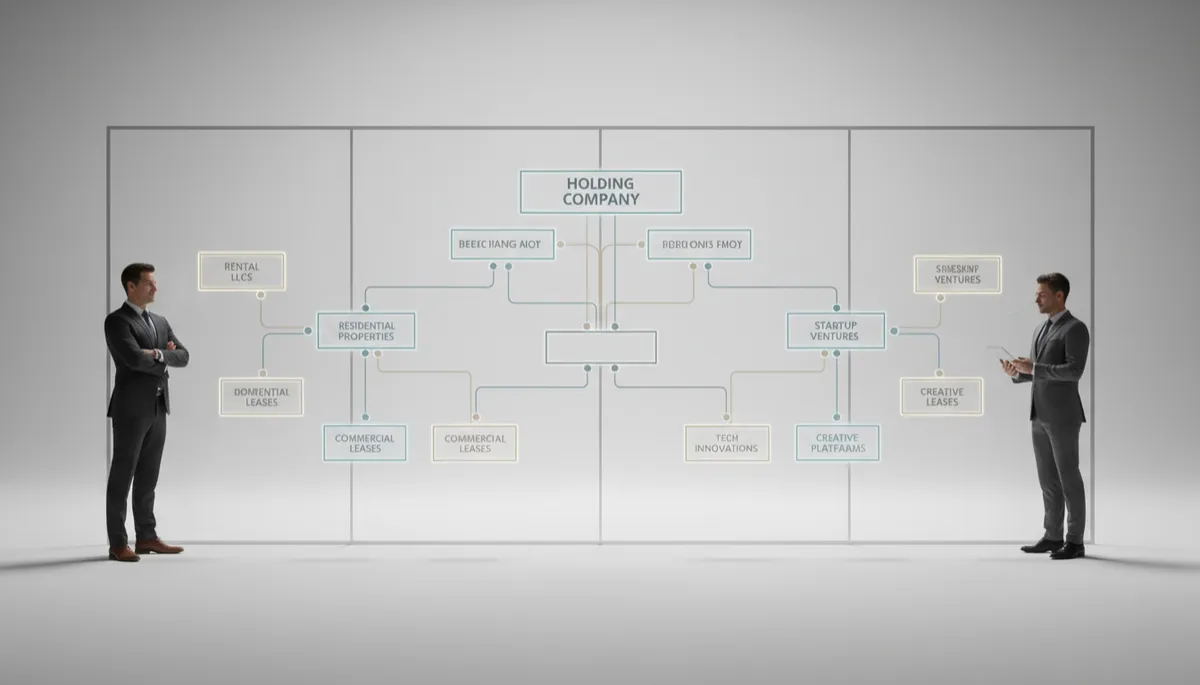
A clear multi-entity map lets you add new ventures without rebuilding your foundation.
Protecting the Core While Experimenting at the Edges
New offers and ventures carry risk. Some will thrive; others will fail. With a thoughtful multiple ventures structure, you can experiment aggressively at the edges while keeping your main cash-producing entity insulated. If a new product line faces a lawsuit or collapses financially, the damage is contained inside that specific LLC or subsidiary, not across your entire portfolio.
This is how large companies innovate without betting the farm each time. There is no reason your agency or mid-sized business cannot use the same playbook on a scale that fits your world.
Expanding into Rentals, Startups, and Subsidiaries: Turning Cash Flow into an Empire
Once your primary business is generating consistent profit, the next question is, “Where should this money go?” High-earning owners often default to leaving cash in the business, taking large distributions, or making random investments. A more intentional investment expansion strategy uses your entity structure to channel profits into:
Rental Properties and Real Estate Holding Companies
Real estate remains a powerful tool for wealth building, tax advantages, and diversification away from your core industry. A common approach is to create one or more LLCs specifically for holding rental properties. Your operating business can:
Pay rent to an LLC that owns your office building, effectively moving money from your operating entity into a long-term asset you control
Allocate a portion of annual profit into a real estate holding company that acquires residential or commercial rentals
Each property sits in its own LLC or series, reducing cross-liability. Over time, your “side” rental portfolio can rival or even exceed the value of your original business, all supported by the cash it generated.
Startup Investments and Strategic Equity Plays
As your network grows, you will encounter opportunities to invest in startups, joint ventures, or other agencies. Instead of investing personally each time, a dedicated investment LLC or C-Corp can:
Hold minority stakes in startups you advise or support
Own equity in software tools or media properties connected to your core audience
Participate in revenue-sharing deals or licensing agreements
By keeping these plays inside a dedicated entity, you simplify accounting, protect yourself from certain liabilities, and create a clean story for future buyers or partners who want to understand your broader portfolio.
Subsidiaries and Spin-Offs: When a Venture Deserves Its Own Life
Some ventures start as side projects inside your main company but grow into standalone businesses. With the right structure, you can convert a product line or division into a subsidiary that:
Has its own P&L, leadership, and brand identity
Can bring on investors or partners without touching your other entities
May eventually be sold or merged while you retain your other assets intact
This is where a thoughtful multiple ventures structure shines. Every new entity is not a random one-off; it is another piece in a coherent, scalable architecture designed for investment expansion and long-term control.
Where Big Life Financial Fits: Guidance for Building a Scalable, Investment-Ready Structure
Designing and maintaining this kind of structure is not something most business owners should attempt alone. It requires coordination between tax strategy, legal entity design, insurance, retirement planning, and real-world business operations. That is exactly where Big Life Financial comes in.
Big Life Financial specializes in helping entrepreneurs, agencies, and growing companies engineer business scalability at the structural level. Instead of handing you a one-size-fits-all LLC or S-Corp recommendation, they look at:
Your current entities, cash flow, and tax exposure
Your goals for new ventures, acquisitions, and investment expansion
Your appetite for rentals, startups, and subsidiaries over the next 5–10 years
From there, they help you build a layered entity design that can grow with you. That might include:
Restructuring your existing LLC into an S-Corp for more efficient active income
Creating a holding company to own your brand, IP, and equity in future ventures
Setting up real estate and investment entities to capture and protect the wealth your business creates
💡 Pro Tip: The earlier you involve a team like Big Life Financial, the easier it is to design a structure that can handle the next five ventures you have not even dreamed up yet.
Practical First Steps to Build an Infinitely Scalable Business Structure
If you are running a growing agency or business and want your structure to match your ambitions, here are concrete steps to begin aligning with the principles in this article:
Audit your current entities. List every LLC, corporation, and DBA you have, along with what they own and how money moves between them. Most owners discover hidden complexity and risk at this stage.
Clarify your 5–10 year vision. Do you want rentals? Startup equity? Subsidiaries? A potential sale? Your multiple ventures structure should be built for where you are going, not just where you are now.
Map your ideal layered entity design. With the help of professionals, sketch a future-state diagram: holding company, operating company, IP entity, real estate LLCs, and investment entities. This becomes your roadmap.
Phase in changes. You do not have to rebuild everything overnight. Start with the highest-impact shifts: perhaps electing S-Corp status, forming a holding company, or carving out a real estate entity for your building.
Establish rules for new ventures. Decide in advance how new offers, brands, and investments will be structured. This keeps your architecture clean as you grow.
Working with a partner like Big Life Financial can accelerate each of these steps. They bring the technical expertise, but just as importantly, they understand the mindset of entrepreneurs who are building not just a business, but a legacy of assets and opportunities.
Conclusion: Design the Structure Before You Need the Scale
Infinite scalability is not about working more hours or endlessly chasing new clients. It is about building a structure that can support multiple ventures, investments, and income streams without collapsing under its own complexity. By embracing layered entity design with LLCs, S-Corps, and C-Corps, you create a flexible framework where each entity has a job and every dollar has a purpose.
When income flows through tax-efficient paths, more of your hard-earned profit is available for investment expansion into rentals, startups, and subsidiaries. When each new venture plugs into a pre-planned multiple ventures structure, you can grow faster without losing control. And when your structure is guided by experts who live and breathe this work, like Big Life Financial, you dramatically reduce the risk of expensive mistakes.
If you want your agency or business to become a true platform for wealth – one that can support multiple entities, investments, and opportunities for years to come – start with the foundation. Redesign your structure for scalability now, so that when the next opportunity appears, you are not scrambling to figure out where it fits. You already have a system built to hold it, grow it, and protect it. Sometimes, a conversation can reveal details that words on a page simply can’t. Watch the video to hear more of the thinking, experiences, and insights that inspired this article.
