
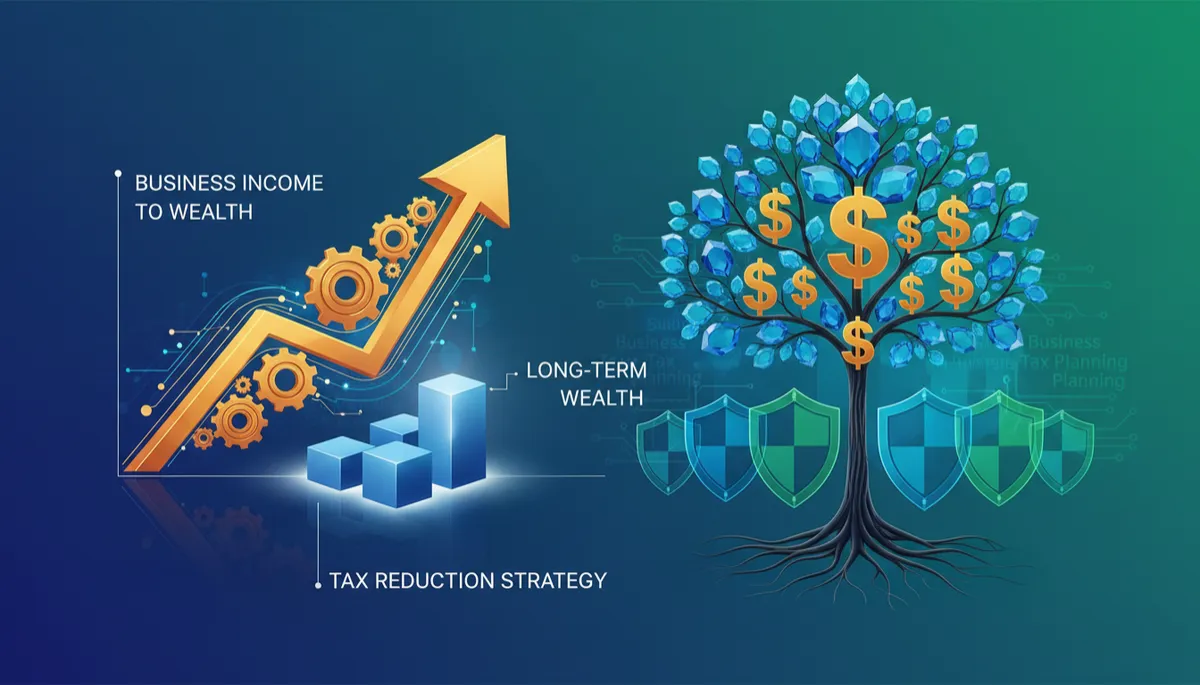
Smart Tax Planning for Business Wealth Growth
Business Tax Planning, Long-term Wealth, Financial Growth
Reducing Taxes as Part of the Business-to-Wealth Transition
How smart business tax planning helps you keep more of what you earn and turn business income into lasting, long-term wealth.
Why “More Revenue” Isn’t the Whole Story
Many entrepreneurs are taught a simple formula for financial growth: sell more, earn more, repeat. But there comes a point where you realize something frustrating—your business is thriving, yet your personal wealth is not growing at the same pace. Cash flows through your company, but too much of it disappears into operating costs and, most painfully, taxes. That is the moment when you need to move beyond simply generating more business income and start focusing on the business income to wealth transition.
At Big Life Financial, we see this all the time: high-earning business owners who are exhausted from chasing the next contract or launch, but who haven’t yet built a clear business owner wealth planning strategy. The missing link is almost always intentional tax planning and wealth coordination. In other words, it’s not just about how much you make—it’s about how much you legally and efficiently keep, and how you deploy those dollars for long-term wealth.
Moving Beyond “Make More” to “Keep More”
Working harder and driving more sales can absolutely grow your top line, but without a tax reduction strategy, your bottom line may not improve much. In higher tax brackets, every additional dollar of business income can be heavily eroded by federal, state, and payroll taxes. That means grinding for growth alone can feel like running on a treadmill—lots of effort, limited progress toward true financial freedom.
A smarter approach is to pair revenue growth with intentional business tax planning. When you design your business and personal finances around strategic tax strategies, you can often create more spendable and investable cash without working more hours or taking on more stress. Reducing your tax bill by $50,000 can have a bigger impact on your personal financial growth than adding $150,000 in new sales with thin margins and high taxes.
💡 Big Life Insight: Every dollar you legally save in taxes is a dollar you can redirect into long-term wealth—without needing to find a new client or launch a new product.
Tax Planning vs. Tax Preparation: The Crucial Difference
One of the biggest obstacles to effective business owner wealth planning is confusing tax preparation with tax planning. Tax preparation is what most people do each spring: sending documents to a tax professional who records what happened last year. It’s backward-looking and compliance-focused. Important? Yes. Sufficient for serious wealth building? Not even close.
Tax planning, on the other hand, is proactive and strategic. It asks questions like:
How should your business be structured to reduce taxes over the next 5–10 years?
Which tax strategies align with your goals for long-term wealth, not just this year’s refund?
How can your business fund investments, retirement, and protection vehicles in tax-efficient ways?
When you combine this type of forward-looking business tax planning with a clear wealth roadmap, you’re no longer just filing returns—you’re building a system that steadily moves business income to wealth.
Keeping More of What You Earn: Core Tax Strategies for Business Owners
While every situation is unique, there are several foundational tax strategies that often help business owners keep more of what they earn. Used together, they can become a powerful tax reduction strategy and a bridge to long-term wealth.
1. Choosing the Right Business Structure
Sole proprietor, LLC, S corporation, partnership—your entity type has a big impact on how your income is taxed. For many growing businesses, shifting from a default structure to a more intentional one can reduce self-employment taxes, open up additional deduction opportunities, and create more flexibility in how you pay yourself. This is a core part of business tax planning that directly affects your ability to convert business income into personal wealth.
2. Maximizing Legitimate Business Deductions
Many owners underutilize deductions simply because they don’t know what is possible or they lack a system for tracking expenses. Travel, education, home office, equipment, and even certain family employment arrangements can all be part of a well-designed tax reduction strategy. The goal is not to stretch the rules, but to fully use the incentives that the tax code offers to business owners who invest in growth and operations.
3. Using Retirement and Investment Accounts Strategically
Retirement plans are one of the most powerful tools for aligning tax planning and wealth. Options like SEP IRAs, Solo 401(k)s, and defined benefit plans allow you to move significant amounts of business income into tax-advantaged accounts. This not only reduces your current-year taxable income but also builds long-term wealth that can grow with favorable tax treatment for decades.
4. Coordinating Business Cash Flow with Personal Wealth Goals
A common mistake is treating business finances and personal finances as two separate worlds. In reality, the whole point of your company is to support the life and financial growth you want. Effective business owner wealth planning means designing how and when money leaves the business—through salary, distributions, bonuses, or benefits—to support both tax efficiency and wealth creation. This includes funding investments, paying down high-interest debt, and building reserves in a deliberate, tax-aware way.

Coordinated tax and wealth planning turns business profits into lasting, compounding assets.
Connecting Tax Reduction with Long-Term Wealth Creation
Tax reduction on its own is not the end goal. What truly matters is what you do with the money you save. When you intentionally connect your tax reduction strategy with a clear wealth plan, every dollar you keep can be assigned a job that supports long-term wealth and a bigger life for you and your family.
The Power of Redirecting Tax Savings into Assets
Imagine your business tax planning helps you save $40,000 in taxes this year. You could let that money quietly disappear into lifestyle creep—or you could treat it as fuel for financial growth. Redirected into income-producing assets, that $40,000 might become:
A down payment on a rental property that generates monthly cash flow
Contributions to retirement accounts that grow tax-deferred for decades
A diversified portfolio of investments aligned with your long-term wealth goals
Over 10, 20, or 30 years, the compounding effect of consistently redirecting tax savings into assets can be enormous. This is where the phrase business income to wealth becomes real—not as a slogan, but as a measurable result in your net worth and your freedom of choice.
Aligning Tax Strategies with Your Big Life Vision
Numbers matter, but so does meaning. At Big Life Financial, we encourage clients to start with the big picture: What kind of life do you want your business to fund? Early retirement? More time with family? Philanthropy? Travel? Once you are clear on your vision, we can design tax strategies and wealth systems that support it instead of working against it.
For example, if your goal is flexibility, your business owner wealth planning might emphasize building liquid, low-volatility assets and keeping your fixed expenses light. If your goal is to leave a legacy, your tax planning and wealth approach might focus more on estate strategies, gifting, and tax-efficient transfers to the next generation. In each case, tax reduction is a tool, not the destination.
📌 Key Takeaway: The real payoff of tax planning comes when you intentionally channel your savings into assets and experiences that match your definition of a “big life.”
A Simple Framework for Your Business-to-Wealth Transition
To bring this all together, here is a straightforward framework you can use to start moving from just earning to systematically growing long-term wealth through your business:
Clarify your wealth vision. Define what financial independence and a “big life” look like for you—income needs, lifestyle, impact, and timeline.
Audit your current tax situation. Work with a professional team to review your entity structure, deductions, and current tax strategies for missed opportunities.
Design a proactive tax reduction strategy. Implement specific, legal strategies to reduce your tax burden over the next 3–5 years, not just this year.
Connect tax savings to investments. Decide in advance how much of every tax dollar saved will be redirected into retirement accounts, real estate, or other wealth-building assets.
Review and adjust regularly. As your business and life evolve, update your business tax planning and investment strategy so they continue to serve your goals.
When to Bring in a Professional Partner
You don’t need to become a tax expert to benefit from smart planning. In fact, trying to DIY complex tax strategies can sometimes backfire. A better path is to build a team that understands both business tax planning and long-term wealth creation—and who can explain things in clear, friendly language so you stay in control of the big decisions.
At Big Life Financial, we focus on helping business owners move from short-term income thinking to a coordinated business owner wealth planning approach. That means looking beyond this year’s return to design a strategy that supports your financial growth for years to come. Whether you work with us or another trusted advisor, the key is to choose partners who understand both sides of the equation: taxes and wealth.
Turning Today’s Profits into Tomorrow’s Freedom
Your business is one of the most powerful tools you’ll ever have for creating long-term wealth. But that potential is only realized when you move beyond the hustle of generating more business income and start building a deliberate system to keep and grow what you earn. Thoughtful tax planning and wealth coordination can transform your business from a demanding job into a true wealth engine that supports the life you want—now and in the future.
The transition from business-to-wealth doesn’t happen by accident. It happens through clear goals, smart tax strategies, and consistent action. When you align your business tax planning with your personal vision, every contract, every sale, and every tax dollar saved becomes part of a bigger story: your journey to a truly big life.
We could keep adding words to the page, but sometimes it’s better to simply hear the conversation. Set aside a few minutes for the video and explore the ideas from a more personal, conversational perspective.
