
Raising Purpose-Driven Children in Wealthy Families
Family Wealth, Financial Independence, Confidence Building
How businesses and advisory firms can help the next generation grow into confident, purpose-led adults who see family wealth as a tool, not an identity.
When Money Becomes a Mirror: The Identity Challenge of Affluent Families
For families who have built significant family wealth, the hardest conversations are often not about tax strategy, investments, or legal structures. They are about identity. Who will your children become when they never have to worry about paying the bills? What will drive them when the traditional pressures of survival and career advancement are softened or removed entirely?
Businesses, family offices, and advisory agencies are increasingly being asked to support clients with this deeper work. The next generation does not just need financial literacy; they need a sense of personal purpose, a healthy relationship with money, and the confidence that comes from contributing meaningfully to the world. Without this, wealth can quietly erode motivation, distort self-worth, and create dependence that undermines both financial independence and emotional resilience.
From Net Worth to Self-Worth: Helping Children Develop Personal Purpose
Purpose is the antidote to entitlement. When children understand who they are, what they value, and how they want to contribute, money becomes a resource rather than a definition of their identity. Businesses and agencies that serve affluent families can play a powerful role in guiding this process by building structured opportunities for self-discovery into their client experience.
1. Start with values, not vehicles
Too often, conversations with the next generation jump straight to investment accounts, trusts, or business succession. While these are important, they can unintentionally send the message that the child’s primary role is to receive and preserve money. Instead, begin with questions that reveal values and aspirations:
What problems in the world feel important or unfair to you?
When do you feel most energized or proud of yourself?
If money were not an issue, what would you spend your time learning or doing?
These questions move the conversation from “What will you inherit?” to “Who are you becoming?” They lay the groundwork for a purpose that is independent of the family balance sheet, while still honoring the legacy that created it.
2. Link purpose to real-world experiences early
Purpose is not discovered in theory alone. It is shaped in the friction of real life—through work, service, and challenge. Businesses and agencies can design programs that connect young people with experiences aligned to their emerging interests:
Internships in fields they are curious about, even if unrelated to the family business.
Volunteer opportunities where they see the impact of their time, not just their donations.
Short-term projects—like organizing a fundraiser or launching a small venture—that require initiative and follow-through.
Each experience reinforces the idea that their identity comes from what they create, learn, and contribute, not simply from the scale of their family wealth.
3. Normalize evolving purpose over time
One hidden pressure in affluent families is the expectation that children must “have it all figured out” because they have so many options. Agencies can relieve this pressure by framing purpose as something that grows and changes over a lifetime. The goal is not a perfect, final answer at age 18, but a habit of reflection and intentional choice. This mindset makes it easier for young adults to try, fail, pivot, and learn—key ingredients in building genuine confidence.

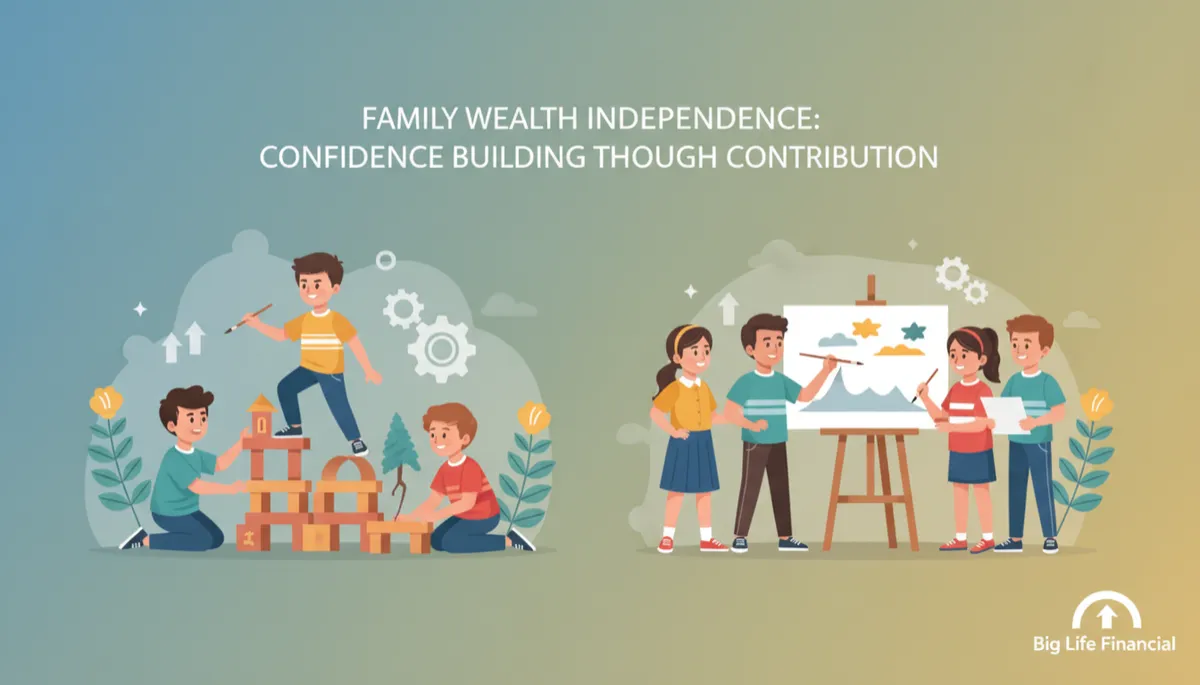
Structured projects let young adults test ideas and build confidence beyond family resources.
Avoiding Dependence on Family Wealth Without Withholding Support
Many parents fear that providing too much will weaken their children, while providing too little will feel like punishment. The real opportunity lies in designing support that encourages financial independence instead of quiet dependence. Businesses and agencies can guide families in creating frameworks that are generous, but not disabling.
1. Shift from automatic entitlement to earned access
Instead of simply handing over assets at a certain age, families can tie access to meaningful milestones that reflect maturity and responsibility. For example:
Completion of financial education modules and regular check-ins with an advisor.
Demonstrated savings habits or income from work or entrepreneurship before matching contributions are released.
Participation in family governance, philanthropy, or strategic planning meetings.
This approach sends a clear message: wealth is a partnership, not a paycheck. It respects the child as an emerging adult capable of contribution, not just consumption.
2. Teach the mechanics of money as a life skill, not a luxury
Knowledge is one of the most powerful tools for reducing dependence. When children understand how money is earned, invested, protected, and grown, they are more likely to steward it well and less likely to feel helpless without it. Agencies can design age-appropriate learning paths that cover:
Budgeting, cash flow, and the basics of personal financial independence.
How the family business or investments actually generate returns over time.
The real costs of lifestyle choices—from housing and travel to education and philanthropy.
When young adults can read a statement, ask informed questions, and make basic decisions, dependence on family members or advisors is replaced with collaborative partnership. They move from passive recipients to active stewards of family wealth.
3. Encourage earned income, even when it is not financially necessary
One of the most practical ways to avoid dependence on family resources is to normalize work. This does not mean pushing children into high-pressure careers they do not want, but it does mean giving them the experience of creating value and being rewarded for it. Part-time jobs, internships, entrepreneurial experiments, or roles in the family enterprise all build the muscle of self-reliance. The paycheck may be small relative to the family’s assets, but the psychological impact is enormous: “I can generate my own income. I am not trapped by my last name.”
📌 Key Takeaway: Strategic support should expand your children’s capacity to stand on their own, not quietly convince them they never could.
Building Confidence Through Contribution, Not Consumption
Confidence built on status, possessions, or access to exclusive experiences is fragile. It depends on maintaining appearances and often crumbles under real challenge. In contrast, confidence built through contribution—through solving problems, serving others, and creating value—tends to be deep and durable. It is the foundation of genuine confidence building within wealthy families.
1. Redefine “success” in family narratives
Children absorb what their family celebrates. If every story at the dinner table is about deals closed, properties acquired, or returns achieved, it is easy for them to assume that money is the only scoreboard that matters. Businesses and agencies can encourage clients to broaden their definition of success by intentionally highlighting:
Times when family members helped a team, mentored someone, or solved a difficult problem.
Community projects or philanthropic efforts where impact mattered more than recognition.
Personal growth milestones, such as overcoming setbacks or learning new skills.
When contribution is celebrated as loudly as financial wins, children learn that their worth is tied to what they give, not just what they own.
2. Create roles for the next generation inside and outside the family ecosystem
Confidence grows when young people see that they can make a real difference. Agencies can work with families to design meaningful roles for children and young adults, such as:
Serving on a junior philanthropy board with a budget and decision-making authority.
Leading a specific project in the family business, with clear goals and feedback loops.
Spearheading a social initiative, such as a scholarship, community program, or environmental effort.
These roles are not symbolic. They are structured opportunities for confidence building through real responsibility and measurable outcomes. Successes and failures alike become learning experiences that strengthen their sense of capability and resilience.
3. Use philanthropy as a training ground, not just a tax strategy
Philanthropy offers a powerful space for children to connect purpose, contribution, and money. Instead of simply writing checks to favored organizations, invite the next generation into the full process:
Researching causes and evaluating which align most closely with family values.
Meeting with nonprofit leaders to understand real needs and constraints.
Tracking the impact of grants, volunteering, or social investments over time.
When young people see the ripple effects of their decisions, they begin to understand wealth as a tool for change. This fosters humility, gratitude, and a deep sense of responsibility—key ingredients in a healthy identity beyond money.
💡 Pro Tip for Advisors: Build contribution-focused experiences—like philanthropy labs or impact projects—directly into your service offering for multigenerational families.
The Role of Businesses and Agencies in Shaping Identity Beyond Money
While parents carry the deepest influence, businesses and agencies have a unique vantage point. You see the patterns that repeat across families: the heirs who thrive, the ones who struggle, and the subtle choices that make the difference. By expanding your services beyond technical planning into identity and purpose work, you can help clients protect not just their assets, but their legacy of character and contribution.
This might mean hosting workshops for the next generation, offering facilitated family meetings, or partnering with specialists who focus on purpose discovery and confidence building. It means asking deeper questions about what families want their wealth to do in the lives of their children, beyond providing comfort and security. And it means reframing financial independence as the freedom to live aligned with one’s values, not just the ability to live off investment returns.
How Big Life Financial Helps Families Build Identity Beyond Money
At Big Life Financial, we believe that wealth should expand a child’s sense of possibility, not shrink it to a single story about money. Our work with families, businesses, and agencies is built on a simple premise: when the next generation is grounded in purpose, equipped with skills, and confident in their ability to contribute, family wealth becomes a powerful amplifier of impact rather than a source of anxiety or entitlement.
We help clients design strategies that integrate:
Purpose-centered planning that starts with values and vision, then aligns structures and investments accordingly.
Education and coaching for the next generation to build real financial independence skills and emotional resilience.
Contribution-focused experiences that allow children to test ideas, participate in decision-making, and see the impact of their choices.
For agencies and businesses that serve affluent families, partnering with Big Life Financial can deepen your value proposition. Together, we can help your clients move from “How do we protect our assets?” to “How do we raise confident, purpose-driven adults who know they are more than their money?”
Invite the Next Generation Into a Bigger Story
Identity beyond money is not a slogan; it is a daily practice. It shows up in the questions you ask your children, the stories you tell about success, the opportunities you create for them to contribute, and the boundaries you set around support. When families and their advisors work intentionally in these areas, wealth becomes a catalyst for growth instead of a cushion that quietly erodes motivation.
If you are a business, family office, or advisory agency looking to help your clients raise grounded, capable, and generous adults, Big Life Financial is here to support you. We bring together strategic planning, education, and purpose-driven coaching to ensure that the next generation can stand tall—with or without the safety net of family wealth.
Ready to go beyond the numbers? Connect with Big Life Financial to explore programs and partnerships that help families build true financial independence, deep confidence, and a legacy of meaningful contribution.
Take the next step by watching the full video, where you'll find more insights to help you on your financial journey.
