

How Holding Companies and Limited Partnerships Can Power Business Expansion
Business Expansion, Holding Companies, Limited Partnerships, Asset Consolidation, Investment Scaling
Discover how the right mix of holding companies and limited partnership structures can separate control from liability, streamline asset consolidation, and unlock scalable investment strategies for growing businesses and agencies.
Why Structure Matters for Business Expansion
As your business or agency grows beyond a single brand, service line, or location, the way you are structured becomes just as important as the services you offer. Many owners operate everything under one entity for years, only to realize too late that this approach exposes them to unnecessary risk, tax inefficiencies, and operational bottlenecks that slow Business Expansion.
Holding companies and limited partnerships provide a powerful toolkit to solve these problems. By separating ownership from operations, and control from liability, you can protect what you have already built while creating a flexible platform to launch new ventures, investments, or locations with confidence. Firms like Big Life Financial specialize in helping entrepreneurs and agencies design these structures deliberately, rather than leaving them to chance or piecemeal advice.
The Role of Holding Companies in Modern Growth Strategies
A holding company is an entity that primarily owns other companies, assets, or investments, rather than directly operating a customer-facing business. For a growing agency or multi-entity business, a holding company can:
Own the equity of several operating companies (for example, separate entities for your agency, your real estate, and a software product spin-off).
Hold intellectual property, trademarks, or key contracts that are licensed to operating entities, adding a layer of protection and negotiation power.
Serve as the central node for Asset Consolidation, dividends, and reinvestment into new ventures or acquisitions.
Instead of one company trying to do everything, a holding company structure lets you build a portfolio of specialized entities. Each entity can have its own risk profile, partners, and exit strategy, while your holding company quietly coordinates capital and ownership behind the scenes. This is where limited partnerships often enter the picture as a flexible, investor-friendly way to organize ownership and roles.
Limited Partner vs General Partner: The Core Partnership Structure
At the heart of many sophisticated growth strategies is the limited partnership (LP). Understanding the difference between a General Partner (GP) and a limited partner (LP) is crucial if you want to attract capital, protect yourself, and maintain control as your ventures multiply.
What Is a General Partner?
The General Partner is responsible for managing the partnership. In a business or investment context, the GP:
Makes day-to-day and strategic decisions for the partnership or fund.
Has fiduciary duties to the limited partners and the partnership as a whole.
Typically bears unlimited liability for partnership obligations unless shielded by an entity (such as an LLC or corporation) serving as the GP.
In practice, sophisticated structures often use an LLC or corporation as the General Partner, which helps contain that liability. This is one of the design decisions where expert guidance from a firm like Big Life Financial can be invaluable, so that you are not personally on the hook for every decision the partnership makes.
What Is a Limited Partner?
Limited partners are investors in the partnership. They contribute capital, share in profits and losses, but do not manage the day-to-day operations. Key characteristics of limited partners include:
Limited liability—their risk is generally capped at the amount of capital they have invested, assuming they do not take on management roles that could reclassify them as general partners under applicable law.
Passive involvement—they may receive reports, vote on major decisions, or approve certain changes, but they are not running the business day to day.
Preferred access to specific deals or strategies without needing to set up their own operating companies or teams.
This clear division between the General Partner and limited partners creates a structure that is attractive to investors while still allowing founders and agencies to retain control. It also becomes a powerful building block when you combine it with holding companies and multiple operating entities.
Separating Control and Liability: Protecting the People Steering the Ship
One of the biggest strategic advantages of using a holding company with limited partnerships is the ability to separate control and liability. As a business owner or agency principal, you want the power to make decisions and drive growth, but you do not want every risk flowing directly to your personal balance sheet.
Using Entities to Contain Risk
A common pattern looks like this: a holding company owns a separate entity that serves as the General Partner of one or more limited partnerships. Each limited partnership then owns specific assets or operating companies. In this structure:
The GP entity makes the decisions and manages the investments or businesses inside the partnership.
Limited partners supply capital but keep their liability limited to what they contribute.
Your personal assets are further insulated because you are not directly the GP—you own the holding company that owns the GP entity.
This layering may sound complex at first, but it is precisely how many private equity funds, real estate syndications, and sophisticated family businesses operate. A well-designed structure allows you to steer the ship while keeping storms from capsizing your entire financial life. Big Life Financial helps entrepreneurs map these layers in a way that supports both growth and peace of mind.
Control Without Micromanaging Every Entity
Separating control and liability also lets you delegate more effectively. As your organization grows, you may install management teams in different operating companies, while high-level decisions flow through the General Partner and holding company. This allows:
Local autonomy at the operating company level, where managers can respond quickly to market conditions.
Centralized capital allocation and strategy at the holding company and GP level, where you and your partners set direction and decide where profits are reinvested.
Instead of one overloaded entity and one overloaded founder, you get a clear hierarchy of control, responsibility, and liability—an essential ingredient for sustainable Business Expansion.
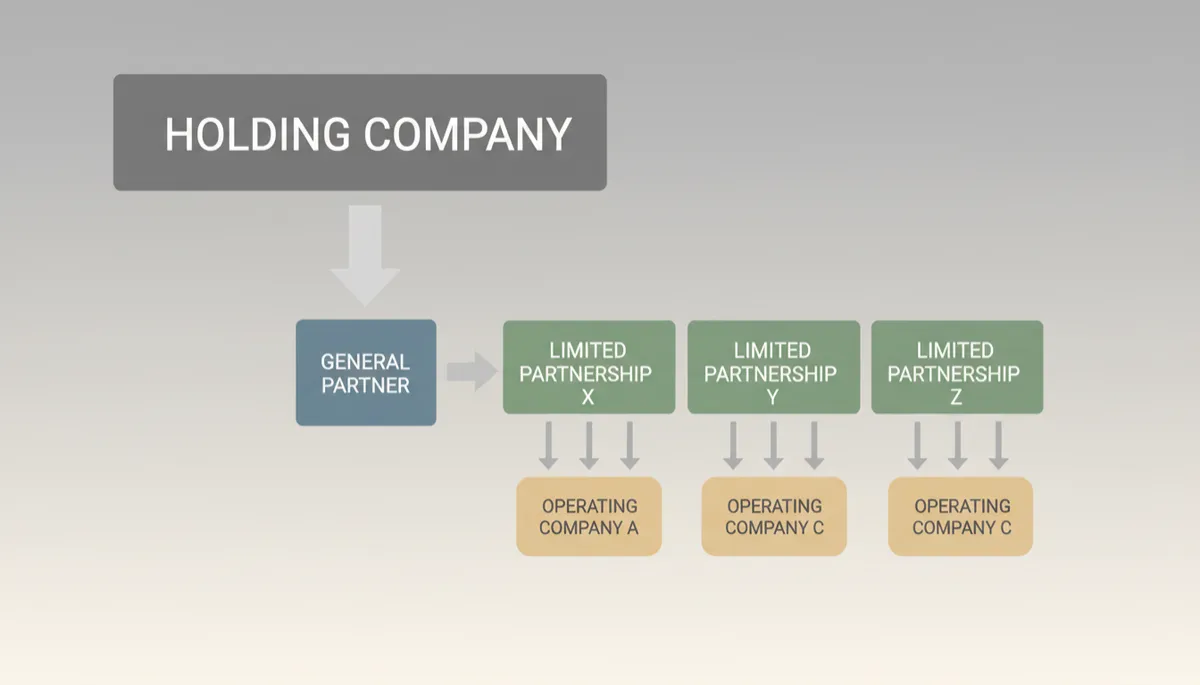
Layered entities separate control, liability, and assets while keeping strategy centralized.
Asset Consolidation Inside Partnerships: Building a Powerful Capital Engine
Another key advantage of limited partnerships is the ability to bring multiple assets and investors under one umbrella. Asset Consolidation inside partnerships lets you pool resources, diversify risk, and create a more compelling story for both internal and external stakeholders.
Consolidating Investments for Clarity and Scale
Imagine you run a growing digital agency that also acquires small software tools, invests in real estate for your offices, and occasionally backs promising start-ups in your niche. Without a coherent structure, you might end up with:
Personal investments mixed with business investments.
Ad hoc ownership percentages with friends or partners that are tracked in spreadsheets or emails.
No clear way to show a bank, acquirer, or investor the full picture of what you own and how it performs.
By contrast, if you use a limited partnership as a central investment vehicle, you can consolidate many of these assets under one partnership. The partnership can hold equity in your operating companies, real estate, or external investments, while the holding company and General Partner manage them strategically. This does not mean every asset must be in one partnership, but it gives you a deliberate way to group and manage them.
Making It Easier to Bring in Capital Partners
When assets are consolidated inside a partnership, it becomes much easier to invite others into your ecosystem. Instead of negotiating one-off deals for every new venture, you can offer limited partner interests in the partnership itself. This approach:
Simplifies documentation and expectations—partners know they are limited partners with defined rights and protections.
Creates a track record at the partnership level, which can be attractive to banks or future investors evaluating your performance.
Allows you to recycle capital from mature or exited investments into new opportunities without rebuilding your structure each time.
For agencies and growing businesses, this can be the difference between sporadic, opportunistic deals and a repeatable investment platform. Big Life Financial often helps clients design partnerships that can hold current assets while remaining flexible enough to absorb future acquisitions or ventures.
Scaling Across Multiple Entities and Investments
Once you have a holding company and partnership framework in place, you can begin to focus on Investment Scaling rather than one-off deals. Scaling across multiple entities and investments means you have a playbook for launching, funding, and managing new initiatives without reinventing the wheel every time.
A Repeatable Blueprint for New Ventures
Consider how much easier growth becomes if you know, in advance, how each new entity will fit into your structure. For example, your blueprint might say:
Every new operating business (a new agency brand, product line, or regional office) is formed as its own LLC, with ownership held by the central limited partnership.
The limited partnership is managed by a GP entity owned by your holding company, which also owns or licenses core intellectual property and systems.
External investors who want exposure to your ecosystem become limited partners in the central partnership, rather than co-owners of each individual entity.
With this structure, scaling from two entities to ten entities is no longer a legal and financial tangle. It is a matter of repeating a known pattern. This is what Investment Scaling looks like in practice: not just buying more things, but doing so within a system that supports clarity, control, and long-term value creation.
Managing Cash Flow and Risk Across the Portfolio
Scaling across multiple entities also lets you smooth out risk and cash flow. Some operating companies may be in aggressive growth mode, reinvesting heavily in marketing or hiring, while others are mature cash cows. Through your holding company and partnerships, you can:
Distribute profits from mature entities up to the partnership and holding company, then redeploy them into new ventures without taking on unnecessary personal debt.
Shield high-value, low-risk assets (such as intellectual property or real estate) in separate entities, away from higher-risk experiments or start-ups.
Present a consolidated view of your portfolio to lenders or strategic partners, even though risk is segmented at the entity level.
This is the structural backbone behind many successful agency groups, roll-up strategies, and founder-led investment firms. Rather than relying on gut feel alone, they design their entities to support Business Expansion as an intentional, repeatable process.
How Big Life Financial Helps Businesses Design These Structures
While the concepts of holding companies, limited partnerships, and General Partner versus limited partner roles are powerful, they can also feel overwhelming when you are busy running a business or agency. That is where specialized advisory firms like Big Life Financial come in. Their mission is to help entrepreneurs and owners build financial and entity structures that align with the bigger life they are creating—not just next quarter’s revenue goals.
Big Life Financial works with clients to:
Map out existing entities, assets, and liabilities to identify where risk is concentrated and where opportunities for Asset Consolidation or separation exist.
Design holding company and limited partnership structures that separate control and liability while keeping decision-making simple and aligned with your vision.
Coordinate with legal and tax professionals to ensure your structure supports both compliance and optimization, rather than creating hidden headaches down the road.
Instead of piecing together advice from random sources, you get a cohesive strategy for Investment Scaling and growth. Whether you are an agency owner planning acquisitions, a business with multiple product lines, or an entrepreneur building a portfolio of ventures, Big Life Financial can help you design a structure that grows with you.
Practical Steps to Get Started with a Better Structure
If you are considering moving toward a holding company and limited partnership model, you do not have to overhaul everything overnight. Here are practical steps you can take to begin aligning your structure with your growth goals:
Inventory your current entities and assets. List every company, property, major contract, intellectual property asset, and investment you are involved in. Note who owns what and where liabilities sit.
Clarify your expansion vision. Are you planning to open new locations, acquire competitors, launch new brands, or invest in adjacent ventures? Your structure should be built with these goals in mind.
Identify where control and liability are currently tangled. Are you personally guaranteeing everything? Are valuable assets sitting in high-risk operating entities? These are red flags to address.
Consult experts who understand both strategy and implementation. Partner with advisors like Big Life Financial to design a holding company and limited partnership framework tailored to your situation, then coordinate with legal and tax professionals to implement it correctly.
The goal is not complexity for its own sake. The goal is clarity, protection, and a structure that makes your next move easier, not harder.
Bringing It All Together for Long-Term Business Expansion
Holding companies and limited partnerships are more than legal jargon—they are practical tools for building a business or agency that can expand confidently across multiple entities and investments. By understanding the Limited partner vs General Partner structure, you gain a framework for inviting capital, sharing upside, and maintaining control. By separating control and liability, you protect yourself and your stakeholders while still steering the overall strategy. By focusing on Asset Consolidation and Investment Scaling, you transform scattered opportunities into a coherent portfolio that compounds over time.
For growing businesses and agencies, the question is not whether you will need a more sophisticated structure, but when. Designing that structure intentionally—rather than waiting for a crisis or a rushed acquisition—can be one of the most valuable strategic moves you make. With guidance from experienced partners like Big Life Financial, you can build a corporate and partnership architecture that supports not only your next move, but the next decade of your growth.
If you are serious about Business Expansion, now is the time to look beyond a single-entity mindset. Think like an investor, act like a portfolio builder, and use holding companies and limited partnerships to turn your ambitions into a scalable, protected, and resilient enterprise.
Got a few more minutes? Settle in with the video and see how the conversation unfolds. You may come across an idea or perspective that gives you something new to consider.
