
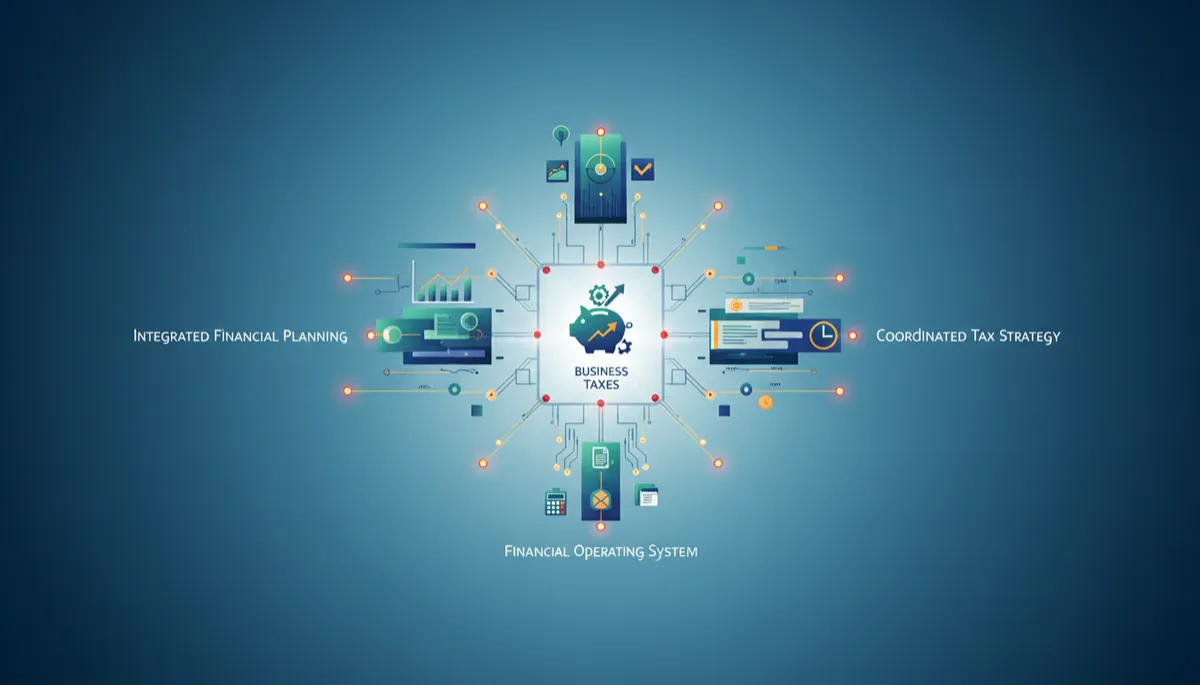
Coordinated Tax Strategy for Financial Success
Business Taxes, Integrated Strategy, Financial Systems, Tax Strategy
Building a Coordinated Tax Strategy for a Stronger Financial Future
A coordinated tax strategy is more than finding deductions at year-end. It’s about weaving tax planning into every part of your financial life so your money works harder, your decisions are clearer, and your long-term goals are easier to reach. At Big Life Financial, we call this connecting your taxes to your overall financial operating system.
What Is a Coordinated Tax Strategy?
A coordinated tax strategy is a deliberate, long-term approach to business tax planning and personal finances that keeps all the moving parts working together. Instead of treating taxes as a once-a-year chore, you integrate tax decisions into the way you:
Earn income (salary, owner’s draws, distributions, bonuses, side income)
Spend money (business expenses, personal lifestyle, debt payments)
Save and invest (retirement accounts, brokerage accounts, real estate)
Protect your wealth (insurance, asset protection, entity structure)
In other words, a coordinated approach is really integrated financial planning with taxes at the center. When your tax strategy is aligned with your cash flow, investments, and business structure, every decision can be evaluated not just on “Is this affordable?” but also “How does this affect my tax bill and long-term wealth?”
💡 Key Idea: Taxes are not just a cost; they’re a design constraint. A smart integrated strategy designs your finances to minimize that cost over decades, not just this year.
1. Connecting Tax Planning with Other Financial Components
Income: How You Pay Yourself Matters
For many business owners, Business Taxes are their single largest expense. Yet decisions about how to pay themselves are often made casually: “Whatever is left in the account” or “Whatever my accountant told me last year.” A coordinated tax strategy looks at:
Salary vs. distributions: How much should be W‑2 wages versus owner draws to balance income tax, self-employment tax, and retirement contributions?
Timing of bonuses: Should you pay a bonus this year or next year based on expected profit and tax brackets?
Multiple income streams: How do your business, rental, and investment incomes interact on your return?
When income planning is integrated with tax planning, you can intentionally shift income across entities, years, and family members to reduce your overall tax burden while still supporting your lifestyle and growth goals.
Cash Flow and Spending: Turning Expenses into Strategic Tools
A coordinated tax strategy doesn’t mean spending money just to get a deduction. Instead, it asks: “What are you already spending money on, and can more of that be structured as legitimate business expenses?” Examples include:
Home office, phone, and internet used for business activities
Travel that combines business meetings or conferences with personal time
Hiring family members in genuine roles within the company
Connecting your spending to your Tax Strategy helps ensure you capture every legitimate deduction while still aligning with your values and long-term plans. You’re not chasing loopholes; you’re aligning your financial life with the tax code on purpose.
Investments and Retirement: Taxes Today vs. Taxes Tomorrow
Many people make investment decisions based on returns alone. A coordinated approach layers in tax impact:
Choosing between tax-deferred accounts (like traditional 401(k)s) and tax-free growth (like Roth accounts) based on your current and expected future tax brackets
Using tax-advantaged accounts for business owners (SEP IRAs, Solo 401(k)s, defined benefit plans) to shelter more income from Business Taxes
Placing tax-inefficient investments (like bond funds) in tax-advantaged accounts and tax-efficient investments (like index funds) in taxable accounts
This is where integrated financial planning shines. Your tax strategy, investment strategy, and retirement strategy should be one unified plan, not three separate conversations.
2. Creating Systems for Reducing Taxes (Instead of One-Off Tricks)
The biggest difference between reactive tax prep and a coordinated tax strategy is systems. Systems make sure smart decisions happen consistently, even when life is busy. At Big Life Financial, we help clients build simple, repeatable Financial Systems that quietly reduce taxes in the background all year long.
System #1: Entity and Compensation Design
Your business structure is one of the most powerful levers in business tax planning. A thoughtful Integrated Strategy looks at questions like:
Should you operate as an LLC, S corporation, C corporation, or a combination?
Is there value in a holding company or management company structure for multiple ventures or real estate?
How will you document and justify your salary as an owner-employee to stay compliant while minimizing payroll taxes?
Once the right structure is in place, it becomes a system: you follow the same playbook each year, adjusting as profits and laws change, but always within a coordinated framework.
System #2: Documentation and Expense Capture
Many entrepreneurs overpay on Business Taxes simply because they don’t have a reliable way to track and document expenses. A simple, well-designed system might include:
A dedicated business bank account and credit card for all business activity
Monthly categorization of expenses in bookkeeping software instead of a frantic year-end scramble
A simple process for saving receipts and notes (for example, snapping a photo and adding a one-line description)
This isn’t about being perfect; it’s about being consistent. A basic system can help you capture thousands of dollars in deductions you might otherwise miss, year after year.
System #3: Proactive Tax Check-Ins
A coordinated tax strategy isn’t set-and-forget. It requires periodic check-ins so you can adjust before it’s too late. A practical rhythm might be:
Quarterly reviews of profit, cash flow, and estimated taxes to avoid surprises and penalties
A midyear strategy session to evaluate major moves (equipment purchases, hiring, retirement contributions, entity changes)
A year-end planning meeting to lock in final moves before December 31
At Big Life Financial, these check-ins are built into the service model, so tax-saving opportunities aren’t left to chance. That’s the power of turning planning into a repeatable system.

Simple recurring systems turn tax planning from last-minute stress into calm, confident decision-making.
System #4: Automation and Guardrails
The best Financial Systems are the ones that keep working even when you’re busy. Automation can help you:
Automatically set aside a percentage of revenue into a tax savings account every week or month
Schedule recurring transfers into retirement accounts or investment accounts aligned with your Tax Strategy
Use alerts and dashboards to flag when profits or spending are off track so you can adjust before tax time
Automation creates guardrails. You don’t have to rely on memory or willpower to do the right thing; the system nudges you in the right direction automatically.
3. Coordinating Tax Planning with a Broader Financial Operating System
Think of your money like a business. A business has an operating system—a set of processes, dashboards, and decision rules that keep everything running smoothly. Your personal and business finances deserve the same structure. When your tax planning is fully coordinated with this broader financial operating system, you move from reacting to leading.
What Is a Financial Operating System?
A financial operating system is the combination of:
Structure: Entities, accounts, and ownership (who owns what, and where money lives)
Flows: How money moves through your world—from revenue to profit, to taxes, to investments, to personal spending
Rules: The decision guidelines you follow (for example, “10–15% of revenue goes to taxes,” “We always max out retirement accounts before taxable investing”)
Tax planning is not a separate layer laid on top. It’s embedded into the structure, flows, and rules from the beginning.
Aligning Business and Personal Worlds
Many entrepreneurs feel like they live in two financial worlds: business and personal. A coordinated tax strategy connects them into one integrated picture. For example:
Your business profit targets include not just growth goals, but also the after-tax income you need to fund your personal lifestyle and savings targets.
Your personal investment strategy is built around the cash flow patterns of your business, so you know when to expect distributions and how to invest them tax-efficiently.
Major life decisions—buying a home, funding college, selling the business—are modeled with both tax impact and lifestyle impact in mind.
This is the heart of integrated financial planning: one connected plan instead of isolated decisions. Taxes become a design element, not an afterthought.
Dashboards, Not Just Tax Returns
A financial operating system needs visibility. Instead of waiting for your completed tax return to see what happened last year, you can use simple dashboards to track:
Current year profit and estimated tax liabilities for your business
Progress toward annual savings and investment goals, adjusted for tax impact
Cash reserves for emergencies and tax payments so you’re never caught off guard
When your data is organized this way, tax planning becomes part of regular decision-making, not a rushed conversation in March or April.
Bringing in the Right Team
Finally, a coordinated tax strategy is a team sport. Your CPA, financial consultant, bookkeeper, and attorney should be aligned around your Integrated Strategy instead of working in separate silos. At Big Life Financial, we often act as the “quarterback,” helping:
Translate your life and business goals into clear financial and tax priorities
Coordinate with your tax preparer so strategy and compliance match up
Make sure your legal entities and documents reflect the plan you’re actually following
When the team is aligned, your coordinated tax strategy becomes the backbone of a resilient financial operating system that can grow with you for years.
Putting It All Together: Your Next Steps
Building a coordinated tax strategy doesn’t have to be overwhelming. You don’t need to become a tax expert; you just need a clear framework and the right support. Here are practical steps to get started:
Map your current system. List your entities, accounts, income sources, and major expenses. Notice where taxes show up—and where they don’t.
Identify quick wins. Are there obvious deductions you’re missing, accounts you could automate, or retirement vehicles you’re not using yet?
Design one new system at a time. Start with something simple, like a tax savings account or a quarterly review habit, and build from there.
Bring in a guide. Work with a financial consultant who understands both Business Taxes and integrated planning—not just tax prep.
Over time, these steps evolve into a complete financial operating system where your tax strategy, cash flow, investments, and business growth all support each other. That’s when money starts feeling simpler, more intentional, and more aligned with the big life you’re building.
📌 Key Takeaway: A coordinated tax strategy is not a single tactic. It’s an ongoing, integrated way of running your financial life so that every dollar is working as hard as you are.
How Big Life Financial Can Help
If you’re ready to move beyond reactive tax filing and into a truly integrated approach, Big Life Financial is here to help. We specialize in building coordinated tax strategy frameworks for business owners and professionals who want their money to support a bigger vision—without getting lost in the weeds of the tax code.
Together, we can:
Connect your tax planning with every major financial component in your life and business
Design simple, sustainable systems for reducing taxes year after year
Build a resilient financial operating system that gives you clarity, confidence, and control
Your tax bill will always be part of the story—but with the right Integrated Strategy, it doesn’t have to be the main character. When your Business Taxes, investments, and cash flow all pull in the same direction, you’re free to focus on what really matters: building a big, bold life on your terms.
No two people take away exactly the same thing from a conversation. Give the video a watch and see which ideas stand out to you, spark a question, or simply give you a different way of looking at the subject.
