
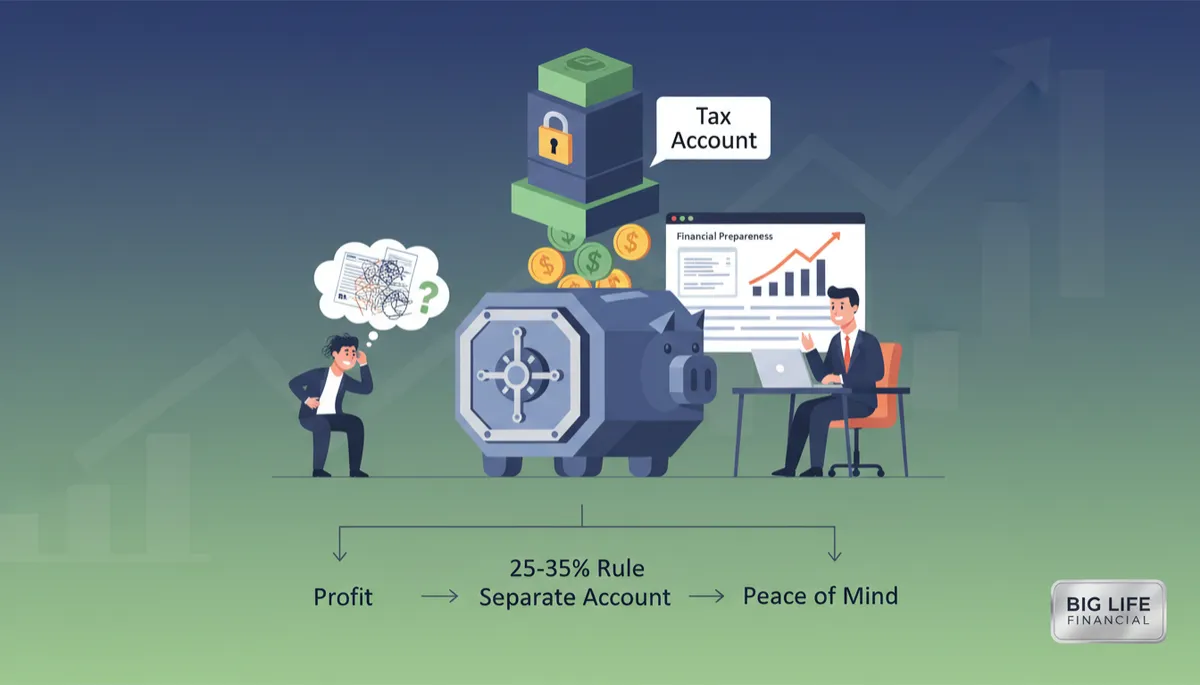
Build a Tax Account for Business Success
Financial Preparedness, Business Taxes, Tax Planning
Stop Getting Surprised by Taxes: How to Build a Tax Account That Works
Tax season shouldn’t feel like a punch in the gut. With a simple, intentional tax account system, local business owners can move from scrambling to pay the IRS to calmly writing a check they already planned for. This guide walks you through why business owners fall behind on taxes and exactly how to build a tax account that finally works for you.
Why So Many Business Owners Fall Behind on Taxes
If you’ve ever opened a tax bill and thought, “Where am I supposed to find that money?”, you’re not alone. Many local business owners run great operations, serve their customers well, and still feel blindsided when it comes to business taxes. The problem usually isn’t laziness or bad intentions. It’s a combination of confusing rules, inconsistent cash flow, and a lack of simple systems for financial preparedness.
Here are the most common reasons owners fall behind on taxes:
Mixing business and personal money. When everything lands in one checking account, it’s easy to forget that part of every dollar belongs to the government, not to you or your business growth plans.
Relying on “leftovers.” Many owners pay expenses, payroll, and themselves first, then hope there will be enough left over for taxes. In slow months, there rarely is, and the tax balance quietly snowballs in the background.
Underestimating what they owe. New owners especially assume that if they’re not hugely profitable, their tax bill will be small. But self-employment taxes, income taxes, and sometimes state or local taxes add up much faster than expected without proactive tax planning.
Irregular income and surprise growth. A great year in sales can turn into a terrible year at tax time. Without a system, that extra profit gets spent before owners realize how much of it is taxable.
Waiting for their accountant to “fix it.” A good tax professional can help you file and reduce what you owe legally, but they can’t go back in time and make sure you saved the cash. That part is on your day-to-day money habits.
The result? Owners end up on payment plans with the IRS, using high-interest credit cards to cover tax bills, or draining personal savings just to stay compliant. The stress of always being behind on business taxes can overshadow the joy of running your company. The good news is that you can fix this with one simple, powerful tool: a dedicated tax account built around the 25–35% rule.
The 25–35% Rule: Your Simple Guide to Setting Money Aside
You don’t need to be a CPA to stay ahead of your tax bill. You just need a clear, consistent percentage to set aside from your profit. That’s where the 25–35% rule comes in. It’s a practical guideline for most small and local businesses to stay tax-ready without overcomplicating things.
What Does the 25–35% Rule Mean?
At its core, the rule says this: for every dollar of profit your business earns, you automatically move 25–35% into a separate tax account. That money is not for rent, not for payroll, not for new equipment, and not for your personal spending. It is reserved strictly for business taxes—income tax, self-employment tax, and any state or local obligations your business faces.
How to Choose Your Percentage
The exact percentage depends on your situation, but you can use these ranges as a starting point and refine them with a tax professional or a partner like Big Life Financial:
25% range: Often works for businesses with lower profit margins, owners in lower tax brackets, or those with strong deductions and credits.
30% range: A solid default for many local businesses, especially service providers and solo owners who pay self-employment tax on most of their income.
35% range: Best for high-profit businesses, owners in higher tax brackets, or those who want a cushion and prefer to be pleasantly surprised by having extra in the tax account.
The key is consistency. A slightly imperfect percentage that you apply faithfully is far better than the “perfect” calculation you never implement. Over time, you can adjust the rate based on your actual tax results, but starting with 25–35% immediately upgrades your financial preparedness.
How to Structure a Separate Tax Account That Actually Works
Knowing the percentage is only half the battle. The real magic comes from how you structure a separate tax account so the money is there when you need it—and out of sight when you don’t. Think of this as building a protective wall between your operating cash and your tax obligations.
Step 1: Open a Dedicated Tax Savings Account
Start by opening a separate business savings account specifically labeled for taxes. This should be with the same bank where you keep your operating account, or a reputable online bank, but it must be clearly distinct. Name it something obvious, like “Business Tax Reserve” or “Tax Savings Only,” so there’s no confusion about its purpose.
Step 2: Keep It Mentally (and Practically) Off-Limits
This is not a backup emergency fund and not a slush account. It’s a holding tank for money that already belongs to the government. Treating it this way is a powerful mindset shift. When you see the balance growing, don’t think, “Great, I have extra cash.” Think, “Good, my tax planning is on track.”
Step 3: Align It With Your Bookkeeping
In your bookkeeping software or spreadsheet, create a category for “Tax Reserves” or “Income Tax Payable.” Each time you move money into your tax account, record it. This keeps your books clean and gives you a clear view of how much of your cash is already spoken for. A partner like Big Life Financial can help you set this up so your tax account integrates smoothly with your overall financial preparedness strategy.

A clear tax reserve plan turns vague anxiety into specific, manageable action.
When and How to Transfer Funds Into Your Tax Account
A tax account only works if money actually lands there—regularly. Deciding when and how to transfer funds is what turns a good idea into a reliable system. The goal is to make contributions automatic and predictable, so you’re never tempted to skip them “just this once.”
Option 1: Transfer Every Time You Pay Yourself
For many local business owners, the simplest approach is to tie tax transfers to the moment you take profit out of the business. If you pay yourself weekly or twice a month, you can:
Calculate your profit for that period (revenue minus expenses, not counting your own pay).
Apply your chosen percentage (say, 30%) to that profit number.
Transfer that amount from your operating account into your tax account the same day you transfer your own pay.
This keeps the process tightly connected to the moment you benefit from your business. You get paid, and your tax account gets paid too. No exceptions.
Option 2: Weekly or Biweekly Tax “Sweep”
If your income is more variable, you might prefer a scheduled sweep. One day each week (or every two weeks), you:
Review your current profit or available cash for the period.
Apply your 25–35% rule to that profit amount.
Transfer the calculated amount into your tax savings account.
Put this on your calendar and treat it like payroll or rent—non-negotiable. Over time, this routine becomes just another part of your business rhythm and a cornerstone of your financial preparedness.
Option 3: Monthly Percentage of Net Profit
Some businesses prefer to wait until their books are closed for the month and then calculate tax transfers based on true monthly net profit. This can be especially helpful if you have large, irregular expenses. The process looks like this:
Close your books for the month and determine your net profit after expenses.
Multiply that profit by your chosen tax percentage (25–35%).
Transfer that amount in one lump sum to the tax account.
A team like Big Life Financial can help you build a simple monthly process that ties this step directly into your bookkeeping and tax planning, so you always know where you stand.
Automate Where Possible
Whichever method you choose, automation is your friend. Many banks allow you to set up recurring transfers from your operating account to your tax account. You can also use rules in your accounting software to remind you of transfers or even trigger them based on certain thresholds. The less you rely on willpower, the more reliable your tax account will be.
Peace of Mind vs. Financial Stress: A Real Comparison
To understand the true value of a working tax account, compare two common experiences for local business owners: one without a system, and one with a consistent tax planning habit.
The Stress Scenario: No Tax Account, Constant Anxiety
In the stress scenario, taxes are a vague worry in the back of your mind all year. You know you’ll owe something, but you’re not sure how much or whether you’ll have enough cash. You avoid looking too closely at your numbers because you’re afraid of what you’ll find. When your accountant finally calculates your tax bill, the number feels like a verdict rather than a predictable outcome of your profit.
The result is a scramble: you delay payments to vendors, cut your own pay, or put the bill on a credit card. Maybe you set up a payment plan with the IRS, which adds interest and penalties on top of what you already owe. This cycle of financial stress drains your energy, distracts you from growth, and can even strain relationships at home as you juggle personal and business obligations.
The Peace Scenario: A Funded Tax Account and Clear Expectations
Now imagine the same year with a functioning tax account built on the 25–35% rule. Each time your business earns profit, a percentage moves quietly into your dedicated tax savings. You see the balance grow month after month, and instead of feeling tempted to spend it, you feel relieved. That money has a job, and it’s doing it well.
When tax time comes, you already have a solid estimate of what you’ll owe because you’ve been tracking profit and setting aside funds. Your accountant confirms the final number, and you simply transfer the money from your tax account to the IRS. No panic, no last-minute borrowing, no sleepless nights. The bill becomes just another planned expense, not a crisis.
📌 Key Takeaway: The real benefit of a tax account isn’t just avoiding penalties. It’s trading constant low-level anxiety for confidence, clarity, and the freedom to focus on growing your business.
How This Approach Solves a Common Pain Point for Local Businesses
For most local businesses, the biggest tax-related pain point isn’t the tax itself—it’s the surprise. Owners feel ambushed by bills they knew were coming but never fully prepared for. That surprise creates a cascade of problems: cash flow crunches, emergency loans, delayed investments, and emotional burnout. A well-structured tax account directly addresses this pain at its source.
Turning a Big Annual Shock into Small, Manageable Habits
Instead of facing one huge, unpredictable bill, you make smaller, predictable transfers throughout the year. This spreads the impact across your normal cash flow and turns a once-a-year crisis into a regular part of your financial preparedness routine. The pain of taxes is no longer concentrated in one stressful moment; it’s smoothed out and absorbed into your operating rhythm.
Separating Emotion from Obligation
A dedicated tax account also creates emotional distance. When all your funds sit in one pile, every payment feels like “your” money leaving. By moving tax money into its own account as soon as it’s earned, you mentally release it. You stop counting it as available cash, which reduces the emotional sting when it’s time to pay the government. The decision was made months ago, not in a moment of panic.
Freeing Up Mental Space for Growth
When you’re not constantly worrying about whether you’ll have enough for business taxes, you gain mental bandwidth. You can think more strategically about pricing, hiring, marketing, and expansion. You can say yes to opportunities without the nagging fear that a tax bill will derail your plans. This shift—from reactive to proactive—can be a turning point in the life of your business.
Where Big Life Financial Fits In: Expert Support for Tax-Ready Businesses
You can absolutely start a tax account on your own. But if you want to maximize the benefits—saving the right amount, using the best strategies, and integrating your tax account with your broader financial goals—having a guide makes a huge difference. That’s where Big Life Financial comes in.
Tailored Tax Planning, Not One-Size-Fits-All Advice
Every business is unique. Your industry, profit margins, growth stage, and personal financial goals all affect how much you should set aside and how your tax strategy should work. Big Life Financial helps local business owners move beyond generic rules and into customized tax planning that fits their real-world numbers. That might mean:
Fine-tuning your 25–35% savings rate based on your actual tax situation.
Identifying deductions, credits, and entity structures that legally reduce what you owe.
Coordinating your tax account with retirement savings, emergency funds, and growth investments.
Building a Complete Financial Preparedness System
A tax account is just one pillar of true financial preparedness. Big Life Financial helps you connect that pillar to the rest of your financial world. That might include:
Cash flow planning so tax savings don’t choke your day-to-day operations.
Profit strategies so you can afford to save for taxes and still pay yourself well.
Long-term planning that aligns your business finances with your personal “big life” goals.
From Tax Panic to Tax Confidence
Many owners first come to Big Life Financial feeling embarrassed or overwhelmed by past tax mistakes. They may be behind on payments, unsure how to catch up, or scared to even open IRS letters. The firm’s approach is practical and judgment-free: start where you are, build a tax account that works, and then layer in smarter strategies over time. The goal isn’t just to survive tax season but to feel genuinely confident about your business taxes every year.
💡 Pro Tip: Don’t wait until you’re “caught up” to build a tax account. Even if you’re on a payment plan now, starting a 25–35% savings habit today is the fastest way to make sure you never end up in the same spot again.
Your Next Steps: Start Your Tax Account This Week
You don’t have to overhaul your entire financial system overnight to stop getting surprised by taxes. You just need to take a few concrete steps in the next week and commit to a simple habit going forward. Here’s a straightforward action plan:
Open a dedicated tax savings account at your bank and label it clearly for tax reserves only.
Pick your starting percentage between 25–35% based on your best estimate or with guidance from a professional.
Choose your transfer rhythm—every time you pay yourself, weekly, biweekly, or monthly—and put it on your calendar.
Make your first transfer this week, even if it’s small. The habit matters more than the amount at the beginning.
Schedule a conversation with Big Life Financial to review your numbers and fine-tune your tax planning so your system is built on real data, not guesswork.
Conclusion: Make Taxes Boring, So Your Business Can Be Exciting
Taxes will always be part of running a business. But tax surprises don’t have to be. By following the 25–35% rule, structuring a dedicated tax account, and committing to regular transfers, you can turn one of your biggest sources of stress into a predictable, manageable part of your financial life. Instead of dreading the next IRS bill, you’ll know you’ve already prepared for it—calmly, consistently, and on purpose.
Local businesses thrive when owners have the confidence and clarity to focus on what they do best. A simple tax account system is one of the most powerful tools you can use to protect that focus. And you don’t have to do it alone. With guidance from Big Life Financial, you can connect your tax account to a broader strategy for financial preparedness, long-term wealth, and the kind of business—and life—you’re truly excited to build.
Reading is a great place to start, but sometimes the conversation adds a whole new layer of perspective. Take some time to watch the full discussion and hear the insights firsthand.
